
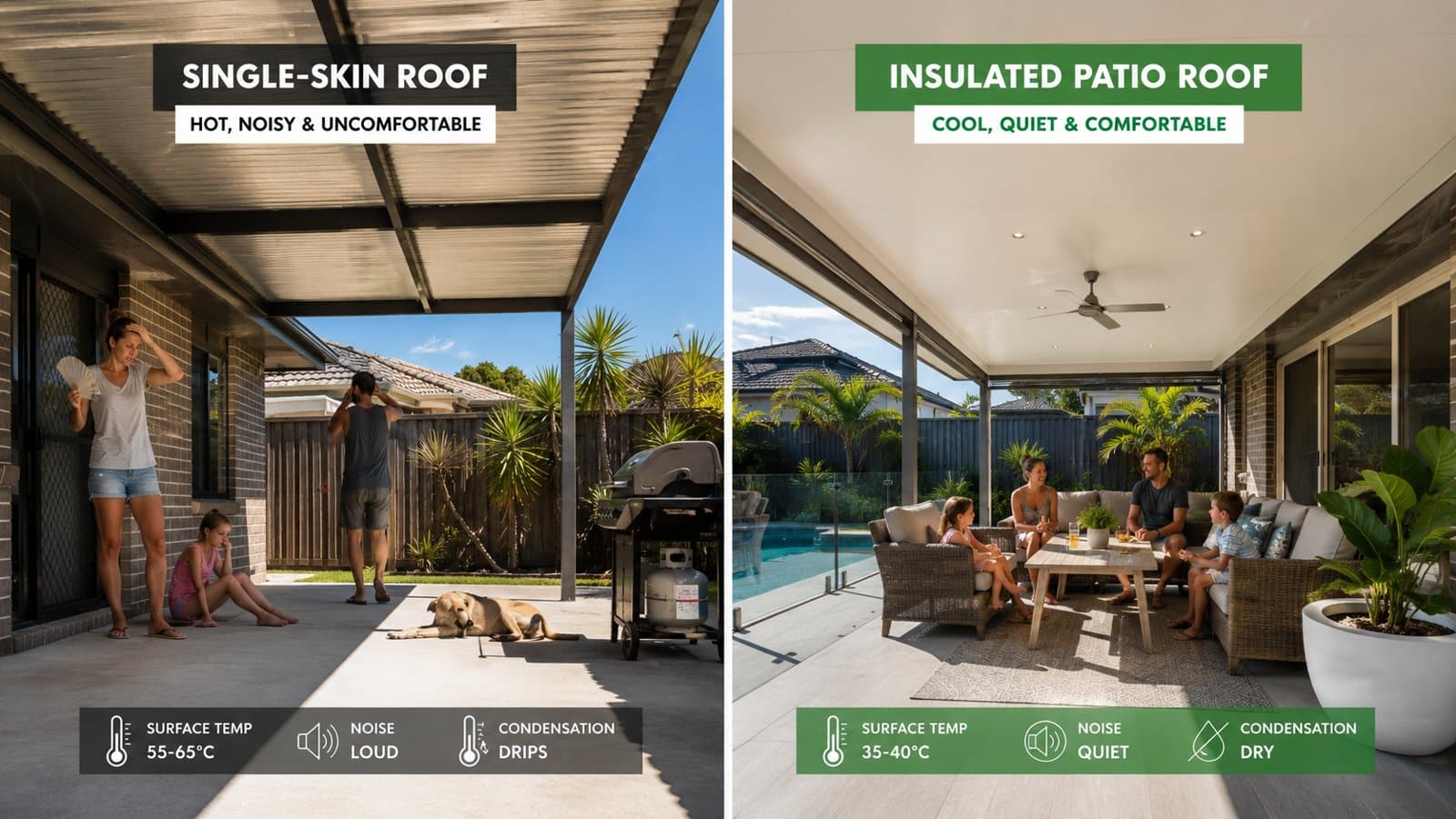
An insulated patio is cooler than single skin roofing because it has a foam or polystyrene core sandwiched between two steel sheets, which blocks radiant heat from passing through the roof into the space below. A single skin roof is one layer of steel, so when the sun hammers it on a 35-degree Gold Coast day, that heat radiates straight down onto your head, your kids, the dog, and the BBQ. If you’ve ever stood under a tin roof at 1 pm in February and felt like you were being slow-cooked, you already know exactly what we’re talking about.
What Single Skin Patio Roofing Actually Is
Single skin patio roofing is what it sounds like: one layer of pre-painted steel, usually Colorbond, with a high gloss finish. It comes in profiles like corrugated or V-Line, and it’s joined with overlapping clips for a watertight seal. It’s lightweight, cheap to install, and it does the basic job of keeping rain off your head. For decades, this was the standard patio cover across Australia. Most older homes on the Gold Coast still have it.
The advantages are real. It’s affordable, it spans long distances with fewer beams and posts, and you can mix in skylight panels for natural light. If your budget is tight and you just need shade over a small area, single skin still has its place.
Single Skin Patio
One layer of pre-painted Colorbond. Cheap to install, fine for areas you walk past, not areas you sit in.
- Lowest upfront cost
- Lightweight, fast install
- Best for carports and walkways
- Gets hot, gets loud in rain
Insulated Patio Panel
Two Colorbond sheets bonded to a 50 to 75mm foam core. A roof, ceiling and insulation in one panel.
- Cuts radiant heat dramatically
- Quiet in heavy rain
- Built-in finished ceiling
- Fans and downlights mount direct
What An Insulated Patio Roof Is Made Of
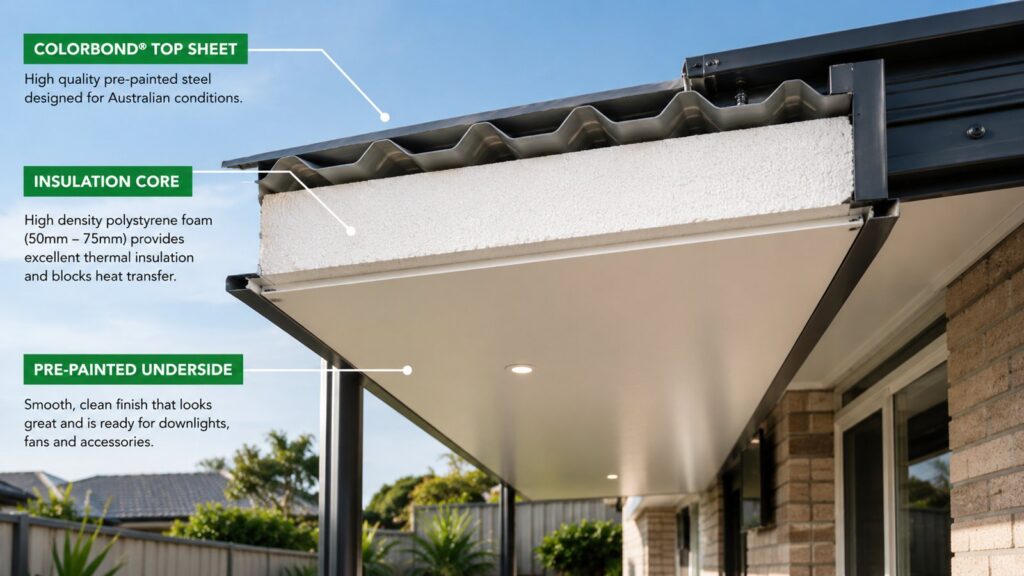
Insulated patio roofing panels are a different beast. Each panel is a sandwich: a top sheet of Colorbond steel, an insulating core of polystyrene foam (usually 50mm to 75mm thick), and a flat pre-painted underside that looks like a finished ceiling. The insulation material is bonded to both sheets at the factory, so the whole thing acts as one solid panel.
That insulating core is the bit doing the heavy lifting. It’s the difference between a roof that radiates heat and a roof that stops it dead.
How Heat Transfer Works Through a Single-Skin Roof
Heat moves three ways: conduction, convection and radiation. A single layer of steel is fantastic at conducting heat. When the sun hits the top, the bottom of the same sheet heats up almost instantly and then radiates that heat downward into your patio. Wave your hand under a hot tin roof in summer, and you can feel the heat coming off it like an oven door.
There’s nothing in the way to stop that transfer. The steel might reflect some of the initial sunlight, especially if it’s a light Colorbond colour, but once the sheet itself is hot, your patio is hot.
Why Insulated Panels Keep Your Patio Significantly Cooler
The insulating core inside an insulated patio roof acts as a thermal break. The top steel sheet still gets hot in the sun, but the polystyrene layer in the middle stops that heat from conducting down to the underside. The ceiling you’re sitting under stays close to the ambient air temperature, which is dramatically cooler than a baking single skin roof.
This is the same principle that keeps a cool room cold or an esky icy. The insulation isn’t doing anything magic; it’s just refusing to let heat pass through.
Roof Underside Temperature on a 35°C Gold Coast Day
Surface temperature radiating down onto people, furniture and pets, measured midday in direct sun.
A 25 to 30 degree gap is what separates a patio you avoid in February from a patio you actually use. Figures based on typical Gold Coast midday readings in direct sun.
Real Gold Coast Temperature Differences Between The Two Roofs
On a 33 to 35 degree summer day on the Gold Coast, the underside of a single skin Colorbond patio roof can hit 55 to 65 degrees by midday. The underside of an insulated patio panel in the same conditions usually sits within 3 to 5 degrees of the air temperature, so around 35 to 40 degrees. That’s a 20-degree difference in the surface radiating heat onto you.
Here’s the rough comparison most homeowners notice:
| Feature | Single Skin Roofing | Insulated Patio Roofing |
|---|---|---|
| Roof underside temp on a 35°C day | 55 to 65°C | 35 to 40°C |
| Cooling effect on adjacent rooms | Minimal | Noticeable |
| Noise during heavy rain | Loud, drum-like | Whisper-quiet |
| Lights and ceiling fans | Need separate beams | Mount directly into the roof |
| Condensation drips | Common | Rare |
| Finished ceiling look | No | Yes |
| Lifespan and durability | 15 to 25 years | 25+ years |
That one column on the right is the reason patios that used to be too hot to sit under from 11 am to 3 pm suddenly become the most used part of the house.
What People Assume About Insulated Patios vs What Actually Happens
Noise Reduction In Heavy Summer Downpours
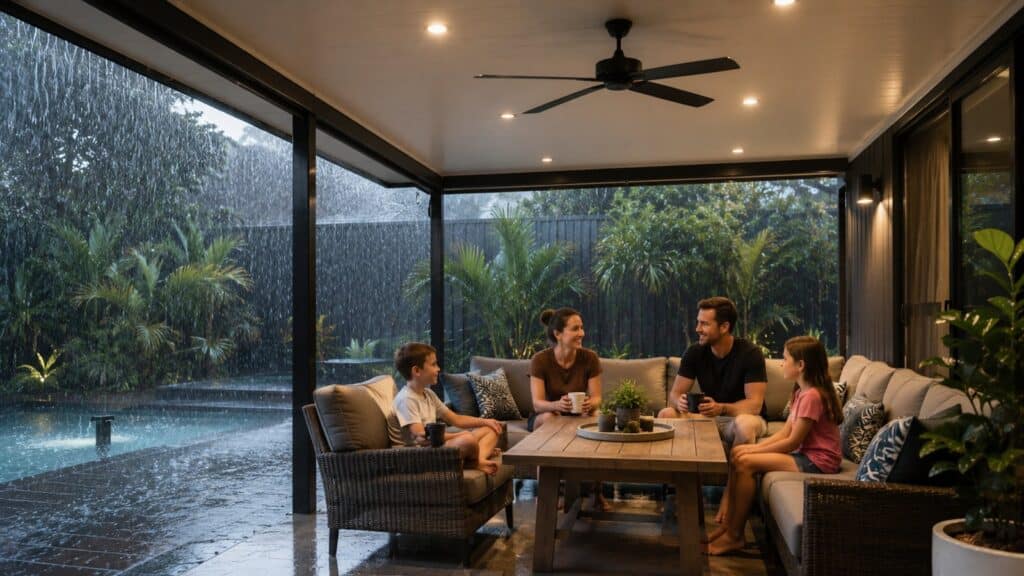
If you’ve ever tried to have a conversation under a tin roof during a Gold Coast summer storm, you know it can’t be done. Single skin steel acts like a drum: rain, hail, and debris all hammer straight through. Insulated patio roofing systems dampen that sound dramatically because the foam core absorbs the vibration before it reaches the room below. You can sit out there with the kids during a downpour and still hear the TV.
Condensation, Drips, and Mould Issues With Single Skin
Single skin roofs have one annoying habit: condensation forms on the cold underside on humid mornings, then drips down onto whatever’s below. Over time, that leads to staining, mould patches, and rusted fixtures. Insulated panels eliminate the cold underside, so condensation doesn’t form. No drips, no mould, no surprise stains on the outdoor lounge cushions.
Lights, Ceiling Fans, and That Finished Ceiling Look
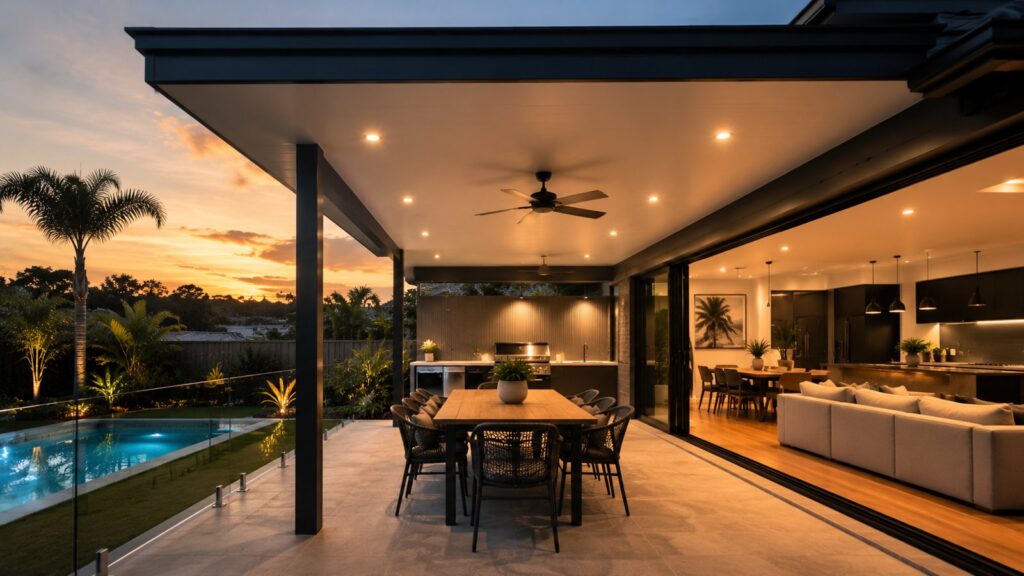
The flat, painted underside of an insulated panel doubles as a ceiling. You can mount downlights, ceiling fans, speakers and even hidden ducting straight into it without the framing gymnastics required for single skin. The result looks like a proper extra room of the house, not a tacked-on shed. For anyone wanting their patio carport area to feel like a genuine outdoor living space, this is where insulated wins by a mile.
Energy Savings On Cooling The Rooms Next To Your Patio
Here’s the bit a lot of patio builders gloss over: an insulated patio doesn’t just keep the patio cooler, it keeps the rooms next to it cooler too. A scorching single skin roof radiates heat against the wall and windows of the adjoining rooms, so your air-con works harder. An insulated patio cuts that heat load, which means the air-con cycles less often and your power bill drops over a hot summer. We’ve had clients report 10 to 20 percent lower cooling costs after switching from single skin to insulated.
Cost Difference and Long-Term Value Over The Lifetime Of The Roof
Insulated panels cost roughly 30 to 50 percent more upfront than single skin roofing for the same span. That’s the honest number. Over a 20 to 25 year lifespan, when you factor in the cooling savings, the comfort, the noise reduction, the finished ceiling look and the bump it gives your property value, the maths usually flips in favour of insulated. You’re not paying for a fancier roof; you’re paying for a usable outdoor living area instead of a hot tin shed.
Where The Real Cost Difference Actually Sits
When Single Skin Still Makes Sense And When It Doesn’t
Single skin still makes sense for:
- Covered walkways or carports where you don’t sit and entertain
- Tight budgets where insulated isn’t an option
- Sheds and storage areas
- Shade over an area that already has good airflow and trees
It doesn’t make sense if:
- You actually want to use the patio between 11 am and 3 pm in summer
- You’re planning to install ceiling fans, lights, or downlights
- The patio is right against the lounge, kitchen, or main bedroom
- You hate the sound of rain on a tin roof
- You want the space to look like an extension of your home
Choosing The Right Roof For Your Gold Coast Home
Our 3-step process is simple:
- Free Quote & Design Consultation – We come out, measure up, and talk you through roof styles, roof pitch options, colours, and finishes. You get a fixed written quote, no hidden costs.
- Approval & Planning – We handle council paperwork, engineering, and cyclonic wind ratings in-house. You don’t lift a finger.
- Installation & Sign-Off – Most patios are built within a week of approval. Premium Australian-made Colorbond steel, up to 15-year manufacturer warranties on insulated panels, fully insured, QBCC licensed (15200654).
What Happens When You Get In Touch
No pressure visit, no hidden costs, no surprise add-ons. Same three steps every time.
Insulated vs Single Skin Patio Roofing Gold Coast Wide: Suburbs We Cover
We’ve installed insulated and single skin patios across every corner of the Gold Coast over the past 20 years. If your suburb is not listed, give us a call. We almost certainly service it.
If you’ve been sitting on the fence about whether the insulated option is worth the extra money over a single skin roof, the answer for almost every Gold Coast home is yes. The comfort and cooling savings alone pay for the difference, and you end up with an outdoor living area you actually want to use year-round.
Give Patios Gold Coast a call on 0413 696 445 or grab a free quote online. We’ve been building patios across Robina, Burleigh, Helensvale, Carrara, Mudgeeraba, and the rest of the Gold Coast for over 20 years, and we’ll tell you straight whether single skin or insulated is the right call for your place.
Get Honest Advice On Insulated vs Single Skin Patio Roofing
Free quote, fixed written price, no hidden costs. We’ll tell you straight which roof suits your block, your budget and how you actually plan to use the space.
Insulated vs Single Skin Patio Roofing: Common Questions
Can I retrofit an insulated roof over my existing single skin patio?
Sometimes, but it depends on the existing frame, posts and how the roof attaches to your house. We assess the old structure during the free quote. In a lot of cases it’s cheaper and cleaner to replace the lot, especially on patios over 15 years old.
What thickness of insulated panel do I need for the Gold Coast?
For most Gold Coast residential patios, a 50mm or 75mm panel is the sweet spot. 50mm handles 95% of jobs. We move up to 75mm for west-facing patios, larger spans, or where you really want maximum thermal performance.
How long does an insulated vs single skin patio installation take?
Both go up surprisingly quickly. Most jobs are installed within a week of council approval. The roof itself is usually done in a day or two, with the rest of the time for posts, gutters, flashings and electrical if needed.
Will an insulated patio panel rust on the coast?
We only use genuine Australian-made Colorbond steel rated for coastal and cyclonic conditions. For homes within a few hundred metres of the surf, we recommend Colorbond Ultra. Both top and bottom skins are pre-painted, so there’s no raw steel exposed.
Do I need council approval for either roof type?
For most patios attached to your home or over a certain size, yes. We handle all the council paperwork, engineering and cyclonic wind ratings in-house. You don’t lift a finger and we won’t start until certification is locked in.
Is single skin ever the right call?
Yes. For carports where you’re not sitting underneath, for walkways, for sheds, and for tight budgets where insulated isn’t realistic. We’ll tell you honestly when single skin is the smarter spend. We don’t push insulated when it doesn’t suit the job.
Will an insulated patio add value to my house when I sell?
A well-built insulated patio reads as outdoor living area on a real estate listing, not “covered shed”. That distinction matters at sale time on the Gold Coast, where the alfresco lifestyle is half the reason people buy here in the first place.
What warranty do you offer on insulated patio panels?
Up to 15-year manufacturer warranties on insulated panels, plus our own workmanship guarantee. Everything is built to last and backed by local after-sales support, not a 1300 number that takes three days to call back.








Leave A Comment